

Plate processing is not one-size-fits-all. The right method depends on material, thickness, tolerance requirements, edge condition, surface finish, lead time, cost, and how much additional work the part will require after cutting.
Sandmeyer Steel Company offers in-house processing options: plasma cutting, abrasive waterjet cutting, laser cutting, and Machincut processing. Plasma, waterjet, and laser each provide an efficient way to produce cut shapes. Machincut goes a step further by adding machining value when the application requires a more finished component.
Plasma Cutting: Efficient Processing for Heavy Plate
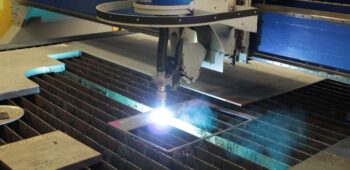 Plasma cutting is often one of the most cost-effective methods for processing thicker stainless steel, nickel alloy, and titanium plate. It uses a high-temperature plasma arc to cut material quickly, making it well suited for larger components, heavier plate, and applications where speed and cost are priorities.
High-definition plasma cutting can improve precision and edge quality compared to conventional plasma cutting. Plasma beveling can also cut and bevel parts in a single operation to help prepare components for fabrication or welding.
Because plasma cutting uses heat, edge condition, taper, tolerances, and heat-affected zones should be considered. Depending on the final requirements, plasma cut parts may require additional processing.
Abrasive Waterjet Cutting: Flexibility Without Heat Input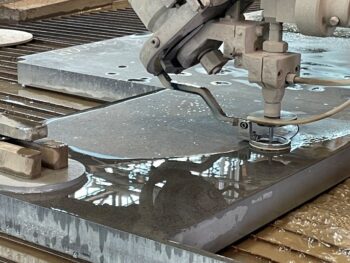
Abrasive waterjet cutting uses a high-pressure stream of water mixed with garnet abrasive to cut material without heat. Because there is no heat-affected zone, it is useful when heat distortion, edge hardening, or thermal stress are concerns.
Waterjet cutting is commonly used for thick plate, complex geometries, near-net shapes, and applications requiring closer tolerances than plasma cutting can typically achieve. Sandmeyer’s abrasive waterjet systems can process stainless steel, nickel alloy, and titanium plate up to 6 inches thick.
For more complex requirements, 5-axis abrasive waterjet cutting can also be used for contour bevels, chamfer holes, and weld bevel preparation. While waterjet provides strong flexibility across a wide range of alloys and thicknesses, it is generally slower and more costly than plasma or laser cutting.
Laser Cutting: Speed and Precision for Lighter Plate
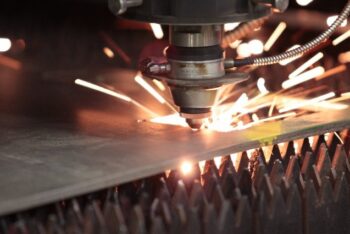 Laser cutting is known for speed, precision, and repeatability on lighter and intermediate thickness plate. It uses a focused beam to cut material with a narrow kerf width and clean edge quality.
Laser cutting is often selected for detailed profiles, clean edge appearance, efficient nesting, and repeat production where consistency is important. At Sandmeyer Steel Company, laser cutting is used to process near-net shapes to close tolerances on material up to 1-1/4 inches thick.
For the right thickness range, laser cutting can provide shorter lead times than waterjet cutting. As plate thickness increases, however, laser cutting becomes less practical compared to waterjet or plasma cutting.
Machincut Processing: A Superior Product at Nominal Extra Cost
Some applications require more than a cut shape.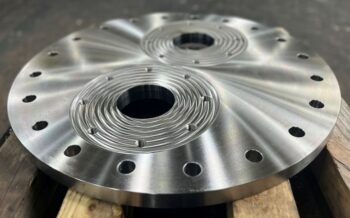
Machincut is Sandmeyer Steel Company’s proprietary process for producing plate components with machined finishes, improved dimensional control, and reduced secondary processing requirements. It is intended for applications where a standard plasma, waterjet, or laser cut part would typically require additional machining before use.
By combining cutting and machining operations, Machincut can help provide:
- Improved dimensional control, including OD and ID concentricity where required
 Machined surfaces and edges
- Eliminated tapered edges
- Closer tolerances
- Improved flatness
- Special non-standard thicknesses
- Tighter thickness tolerances
- Gasket faces, grooves, and counterbores
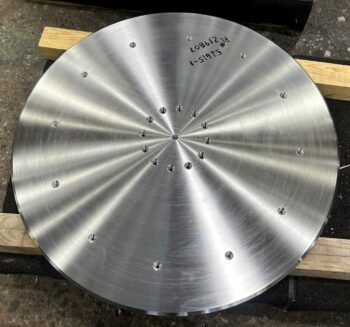 Machined surfaces and edges
Each additional outside machining operation can add handling, lead time, and cost. Machincut incorporates machining into Sandmeyer’s production process from the start, helping deliver a more complete component before it leaves our facility.
Available on material from 3/16 inch through 6 inches thick, Machincut can produce parts up to 120 inches outside diameter or width.
Choosing the Right Option
Plasma cutting is often the most efficient option for heavier plate when speed and cost are key. Waterjet cutting provides flexibility when heat input, geometry, or thicker plate requirements are important. Laser cutting offers speed, precision, and shorter lead times than waterjet on lighter and intermediate thickness plate.
When the requirement goes beyond a cut shape, Machincut provides added machining value. For applications requiring machined features, improved flatness, closer tolerances, special thickness requirements, or a part that can move more efficiently into the next stage of production, Machincut may be the better solution.
Ready to Discuss Your Requirements?
Sandmeyer Steel Company’s in-house processing capabilities include plasma cutting, abrasive waterjet cutting, laser cutting, and Machincut processing. Whether your application requires heavy plate processing, complex geometries, clean edges, close tolerances, or machined features, our team can help determine the most appropriate solution for your requirements.
Explore our Plate Processing capabilities or contact a Sandmeyer Steel Company representative to discuss your application.